
Web1, Web2 and Web3: What Digital Ownership Means
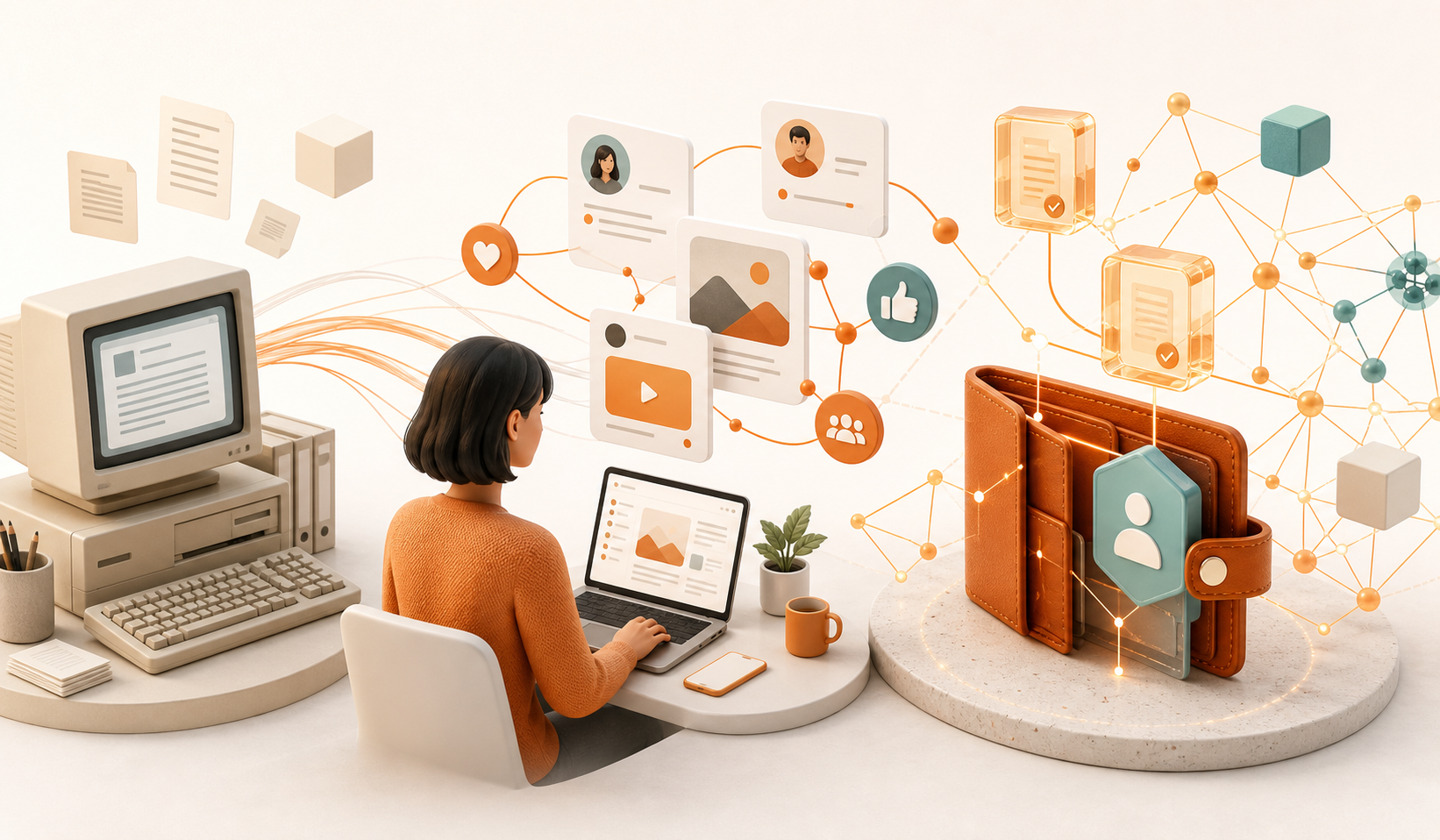
Every major stage of the web changed what a user could do. Web1 opened access to information. Web2 allowed almost anyone to publish and participate. Web3 introduces another possibility: users can control digital assets and verify selected actions without relying only on a platform’s private database.
Web1, Web2 and Web3 are not official software releases with clear start and end dates. They are useful labels for overlapping stages in the development of the web. Older technologies do not disappear when a new model emerges; they continue to work together.
In this article, Web3 refers to the blockchain-centered decentralized-web movement, not the older use of “Web 3.0” for the Semantic Web.
The most important Web3 idea is not cryptocurrency by itself. It is a change in the relationship between users, platforms and digital records: who controls access, who defines the rules and what can be independently verified.
Three Stages in One View
- Web1: users mainly read information published by website owners.
- Web2: users create, communicate and transact through digital platforms.
- Web3: users can also interact through wallets, programmable assets and public blockchain records.
This comparison is intentionally simple. Real products often combine all three models.
Web1: The Web as a Library
Early websites were mostly designed to publish information. A relatively small number of people and organizations created pages, while a much larger audience visited them to read. Sites often resembled digital brochures, libraries or newspapers.
Calling Web1 “read-only” is a simplification. Email, forums and other interactive services already existed. Still, the phrase captures the dominant experience: publishing and updating a website usually required technical knowledge, while most users consumed information rather than continuously creating it.
This was a major breakthrough. Information that once depended on physical distribution or access to a local database could be shared globally through a website. The World Wide Web was developed at CERN beginning in 1989, and the first website explained the project itself. CERN preserves the history of where the Web was born.
Web1 connected documents remarkably well. What it did not yet make easy was mass participation.
Web2: The Web Becomes Participatory
Web2 removed many of the technical barriers to publishing. A user could create a profile, post a message, upload a video, review a product, edit a shared document or build an online audience without running a server.
Platforms provided the infrastructure: hosting, design, discovery, payments, moderation and social connections. This convenience turned the web into an everyday space for communication, business and entertainment.
It also concentrated control. A platform usually owns the account system, stores the data and sets the rules. A profile may feel like a user’s digital property, but access still depends on the company operating the service. Features can change, content can be removed and an account can be restricted.
Centralization is not automatically a flaw. It can provide fast support, password recovery, fraud monitoring and a consistent experience. The trade-off is that users normally cannot inspect the platform’s underlying database or move their full digital identity elsewhere.
Web3 developed partly in response to that limitation.
Web3: From Platform Access to Verifiable Control
Web3 is often summarized as the “read, write and own” web. This is a useful mnemonic, not a formal technical definition. Ethereum.org’s introduction to Web3 presents the idea while also acknowledging its current limitations.
In practice, Web3 ownership usually means control over blockchain-based assets or permissions through cryptographic keys. These may include tokens, digital collectibles, membership credentials or the ability to use a particular application.
A wallet is the main access tool. It does not normally store assets like a physical wallet stores cash. The blockchain records balances and ownership, while a self-custodial wallet typically manages the keys, key shares or credentials used to authorize transactions. Custodial and smart-contract wallets distribute this control differently.
This changes portability. A user may connect the same wallet to several compatible applications. An on-chain record can remain associated with that wallet even if one interface stops operating, although the asset’s utility, metadata, redemption rights and accessible interfaces may not.
However, cryptographic control is not the same as unlimited legal ownership. Holding a token does not automatically provide copyright, ownership of a physical object or permanent access to every related service. Those rights depend on the smart contract, the project’s terms, applicable law and systems outside the blockchain.
Greater control also creates greater responsibility. A lost recovery phrase may be impossible to restore. A malicious transaction can be processed exactly as signed. Web3 therefore changes the distribution of control, responsibility and risk; it does not make those risks disappear.
Why Smart Contracts Matter
Smart contracts are programs deployed to a blockchain. They can define rules for transferring tokens, exchanging assets, issuing credentials, managing collateral or recording votes.
Consider a simple difference. In a conventional platform, a dashboard may show that a payment was completed because the company’s database says so. In a blockchain-based system, the user may also inspect the transaction, destination address and resulting state through an independent block explorer.
This is on-chain verification: different applications can read the same public record instead of depending on a single interface.
The record still needs interpretation. It can show that tokens moved, but not always why they moved, who controls a pseudonymous address or whether an off-chain promise was fulfilled. Public code is not automatically secure code, and a visible transaction is not proof that an entire business is reliable.
Blockchains do not eliminate trust. They can reduce dependence on one record keeper and make selected actions independently observable. Trust then shifts toward the code, data sources, governance, security practices and people operating the surrounding system.
DAOs and Online Coordination
A decentralized autonomous organization, or DAO, is a group or organization that uses blockchain-based tools to coordinate rules, assets or decisions.
Members may submit proposals, vote, delegate voting power or approve the use of a shared treasury. Smart contracts can record results and execute certain approved actions.
The word “autonomous” should not be taken literally. Many DAOs still rely on contributors, forums, legal entities, software teams and multisignature wallets. Voting power may be concentrated, participation may be low and urgent security decisions may require a smaller group to act quickly.
DAOs are therefore better understood as an evolving coordination model, not a universal replacement for companies or communities.
What Web3 Still Needs to Solve
For many people, the main obstacle is not the theory. It is using the products safely.
- User experience: wallets, network selection, transaction fees and token approvals remain difficult for beginners.
- Security: smart contracts can contain bugs, and bridges or external services add further points of failure.
- Privacy: public blockchains preserve activity, while wallet addresses are usually pseudonymous rather than anonymous.
- Decentralization: an application may use smart contracts while still depending on centralized websites, administrators or data providers.
- Governance and regulation: voting systems, legal responsibility and consumer protections continue to vary across projects and jurisdictions.
Web3 products still need clear interfaces, understandable terms, reliable support and credible security practices. A decentralized component does not excuse poor communication or weak accountability.
The Future Is Likely to Be Layered
Web3 is unlikely to erase Web2. The more realistic future is a combination of both.
A Web3 application may use a familiar Web2 interface and cloud infrastructure while recording selected actions on a blockchain. A conventional platform may add wallet-based access or public verification without becoming fully decentralized.
The practical question is not whether Web3 will defeat Web2. It is where users genuinely benefit from portable control, programmable rules and verifiable records—and where a centralized service remains simpler and more appropriate.
The strongest future products may feel as simple as Web2 while giving users Web3-style verification and control where those features matter.

